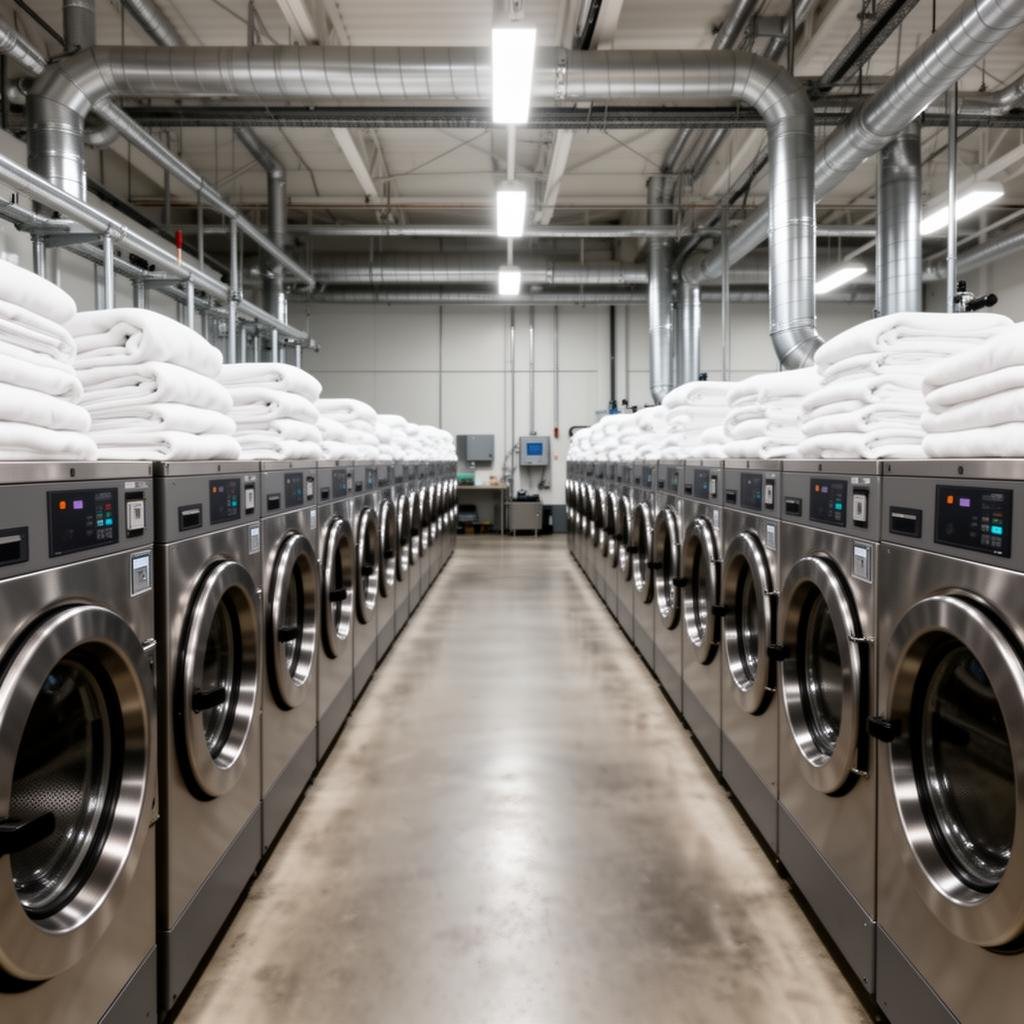
Large-scale institutional laundry operations — managing millions of linen items every year across hospitals, hotel chains, prisons, care homes, and defence facilities — live or die by the quality of the textiles they process. Choose the wrong fabric composition and your linens shred within 50 cycles. Specify the wrong weight and your laundry throughput slows to a crawl. Ignore colour fastness standards and your wards look untidy within six months. The right laundry textile specification is not a minor procurement detail — it is an operational foundation decision with long-term financial consequences. This guide sets out the six most critical criteria for institutional laundry textile selection.
1. Fabric Composition: The First and Most Important Decision
For flat linen in institutional laundry — bed sheets, tablecloths, pillow covers, duvet covers — the choice between 100% polyester, 65/35 polyester-cotton blend, and 100% cotton determines the entire performance profile. 100% polyester withstands the harshest commercial laundry chemistry (high-pH detergents, chlorine bleach, optical brighteners) without fibre degradation over 300+ cycles, and has minimal shrinkage — but lacks the comfort of cotton for patient-facing applications. 65/35 poly-cotton blends are the dominant choice for institution-wide linen programmes, balancing durability with comfort and producing reliable colour fastness results using reactive dyes. 100% cotton, while prized for its natural softness, requires more careful laundry process management to avoid shrinkage and greying over time. For healthcare settings, 65/35 at 180–200 GSM for bed linen and 100% polyester at 190–220 GSM for flat laundry provide the optimum commercial performance.
Source Institutional Laundry Textiles Built for 200+ Cycles
Cambay Industries supplies ISO 9001-certified institutional laundry textiles to healthcare, hospitality, and government buyers across 40+ countries. Explore our full institutional range.
2. GSM: Weight as a Proxy for Quality and Durability
GSM (grams per square metre) is the single most reliable indicator of a linen’s commercial durability and tactile quality. For institutional flat linen, the minimum viable GSM for 200+ cycle performance is 175 GSM for 100% polyester and 195 GSM for poly-cotton. Below these thresholds, the fabric becomes translucent and structurally weak after repeated high-temperature laundering. Premium institutional specifications run to 220–240 GSM for tablecloths and 200–210 GSM for bed sheeting — weights that maintain structural integrity, visual opacity, and a quality hand-feel through the entire service life of the linen. Specifying too low a GSM to achieve a lower unit price is a false economy: lighter linens replace faster, increasing total programme cost.
3. Dimensional Stability: Consistent Sizing After Repeated Washing
Dimensional stability — or more accurately, dimensional instability — is one of the most overlooked specification failures in institutional linen purchasing. Linen that shrinks more than 2–3% in length or width within the first 10 wash cycles creates cascading operational problems: bed sheets that no longer fit mattresses, tablecloths with uneven drop lengths, pillow covers that stick on standard pillows. AATCC Test Method 135 (domestic laundering) and ISO 6330 provide standardised shrinkage testing protocols. For institutional textiles specify maximum 3% shrinkage in both warp and weft directions after 5 commercial wash cycles (60°C with industrial detergent); require the COA to show actual test results, not just a specification claim. Cambay Industries provides full dimensional stability test certificates for all flat linen ranges.
4. Colour Fastness: Maintaining a Professional Appearance Over Time
Institutional laundry uses oxidising bleach chemistry and high-alkalinity detergents at 60–85°C — conditions that destroy poorly dyed textiles within weeks. ISO 105-C06 (colour fastness to washing) and ISO 105-E04 (colour fastness to perspiration) are the relevant test standards. For institutional laundry textiles, specify minimum ISO 105-C06 rating of 4–5 (excellent) for both colour change and staining. Dyes achieving these ratings in commercial laundry conditions are predominantly reactive dyes for cellulosic fibres (cotton and viscose in blends) and disperse dyes for polyester. Accept no linen supplier who cannot provide documented colour fastness test results from an accredited independent laboratory.
5. Soil-Release Finishing and Stain Management
Advanced soil-release finishing applied to polyester and poly-cotton laundry textiles dramatically improves single-cycle stain removal performance. The chemistry temporarily renders the hydrophobic polyester surface hydrophilic during the wash cycle, enabling detergent and water to penetrate the stain interface and remove protein, lipid, and beverage stains that would otherwise require repeat washing or stain chemistry treatment. For institutional laundry operations running tight service cycles, soil-release finishes reduce re-wash rates from a typical 8–15% down to 2–5% — a significant operational gain. Cambay Industries incorporates soil-release technology as standard across all poly-cotton flat linen products in the institutional range.
6. Working with Cambay Industries for Institutional Supply
Cambay Industries supplies institutional laundry textiles to healthcare groups, hotel chains, contract laundry distributors, and government institutions across India, the UK, the UAE, and the EU. Our ISO 9001:2015-certified production facilities deliver consistent quality across large-volume institutional orders, and our documentation package — including dimensional stability test certificates, colour fastness results, OEKO-TEX certification for healthcare-sensitive applications, and country-of-origin documentation for import compliance — is provided as standard on all export orders. Contact our institutional team to discuss product specifications, sample requests, and annual volume pricing programmes. Our related healthcare textiles and hospitality textiles ranges offer specialised products for sector-specific applications within the broader institutional supply framework.
Get Your Institutional Linen Specification Right From Day One
Request a sample pack with test certificates across our full GSM range. 50+ years of institutional textile experience behind every product.
Published by Cambay Industries — specialists in premium textiles and nuts processing since 1970.