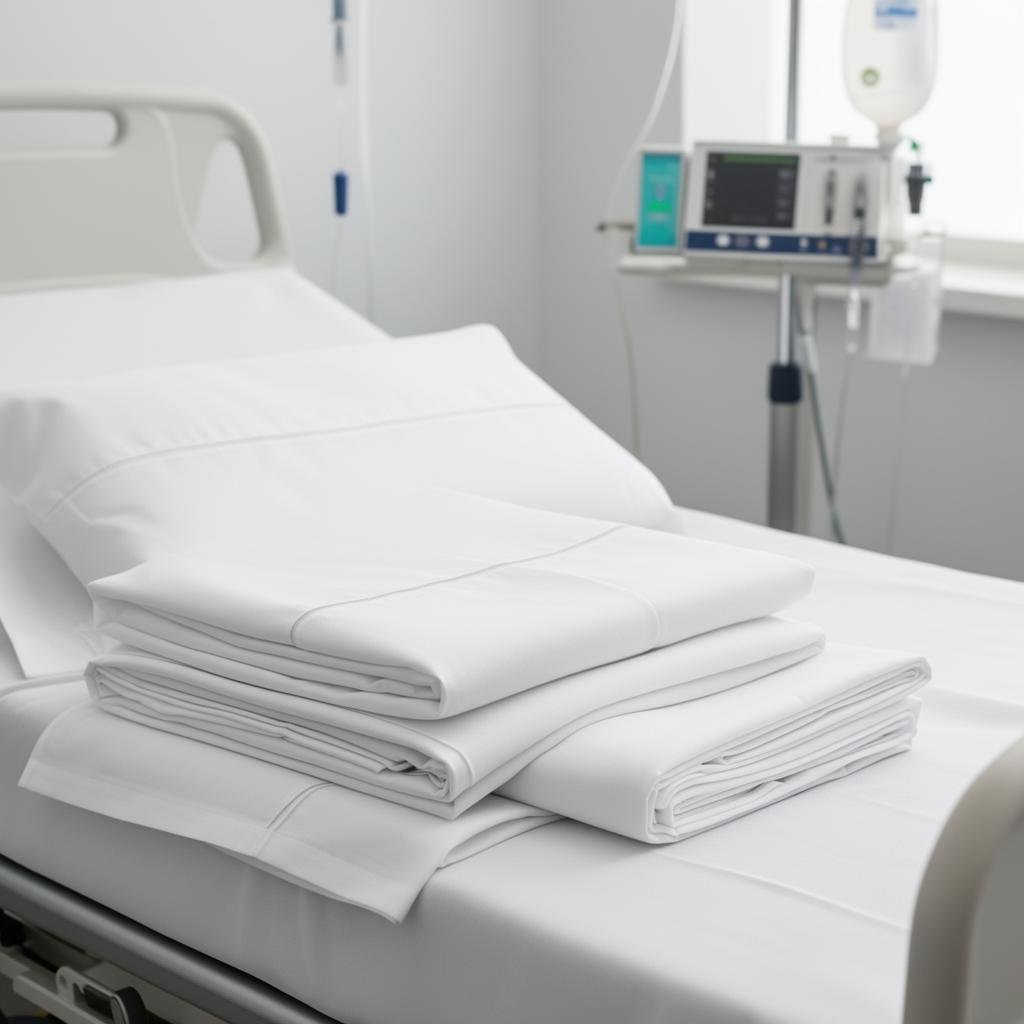
The debate between reusable and disposable healthcare textiles has intensified in recent years as NHS Trusts and private healthcare groups face simultaneous pressure to reduce costs, improve sustainability, and maintain the highest clinical hygiene standards. The argument for disposable clinical textiles — guaranteed single-use hygiene, no laundry dependency, simplified workflow — has significant intuitive appeal. But lifecycle analyses increasingly show that well-managed reusable healthcare textile programmes are not just clinically safe alternatives — they are frequently better on financial, environmental, and sometimes even clinical performance metrics than their disposable counterparts.
The Clinical Evidence on Reusable Healthcare Textiles
A common clinical assumption is that disposable textiles are inherently safer than reusables from an infection control perspective. The evidence is more nuanced. NHS research and Healthcare Infection Society guidance confirms that properly laundered reusable healthcare textiles — washed and thermally disinfected to NHS laundry standard HTM 01-04 — present no greater cross-infection risk than disposable alternatives for the majority of clinical applications. The critical variable is the laundering process itself: textiles processed at 71°C for 3 minutes (or equivalent thermal disinfection conditions) achieve the microbial decontamination required for standard clinical use. Where laundry process control cannot be guaranteed — in isolation scenarios, high-risk infection containment wards, or emergency field settings — disposable products remain clinically appropriate. But for the majority of NHS clinical environments with centralised linen services or accredited OPL operations, reusable textiles are clinically sound.
NHS-Grade Reusable Healthcare Textiles with Full Clinical Documentation
Cambay Industries supplies clinical scrubs, patient gowns, and theatre drapes with NHS-compatible test data. View our healthcare range.
The Financial Analysis
NHS Supply Chain data shows that a standard disposable surgical scrub costs approximately £4-6 per use in the UK market, while a reusable equivalent — amortised over 50 wash cycles at an average per-wash processing cost of £0.80 — costs approximately £0.60-0.90 per use including capital depreciation. The reusable option delivers 85-90% cost saving per use compared to disposable equivalents in surgical garment applications. For high-volume clinical categories — patient gowns, scrubs, theatre drapes — the financial case for reusable programmes is overwhelming. An NHS Trust replacing 500 daily disposable patient gown uses with a managed reusable programme can save £500,000-900,000 annually in product cost alone, with the reusable programme infrastructure (laundry processing, logistics, inventory management) typically costing 40-60% of the disposable product spend it replaces.
The Environmental Impact
A 2021 lifecycle analysis from the University of Cambridge assessed the carbon footprint of reusable versus disposable surgical gowns used in NHS theatre settings. The study found that reusable gowns, when processed in a commercial laundry with modern energy infrastructure, had a carbon footprint approximately 4× lower per use than equivalent disposable gowns — primarily because the embedded carbon of manufacturing the reusable gown is amortised across 50-100 use cycles, compared to the full manufacturing carbon cost incurred with every single disposable use. NHS Trusts with net zero carbon commitments (as required by NHS England’s guidance) should consider accelerating transitions from disposable to reusable healthcare textiles as a cost-effective decarbonisation measure.
Building a Transition Programme
Moving from a disposable to a reusable healthcare textile model requires careful planning. Key steps include clinical risk assessment for each product category, identification of appropriate laundry processing pathways, stocking model development (typically 3-5× the daily use quantity to buffer laundry cycle times), staff training on product handling and laundry process requirements, and robust tracking systems to manage the lifecycle of each item. Cambay Industries works with NHS Trust procurement teams at every stage of this transition, from initial specification and sample evaluation through to par stock calculation and ongoing supply management. Contact our healthcare textile team to begin your transition assessment.
Transition to Reusable Healthcare Textiles
We support NHS and private healthcare textile transitions from specification through to ongoing supply. Also see our scrubs and patient gowns.
Published by Cambay Industries — specialists in premium textiles and nuts processing since 1970.